View Detailed Image Description
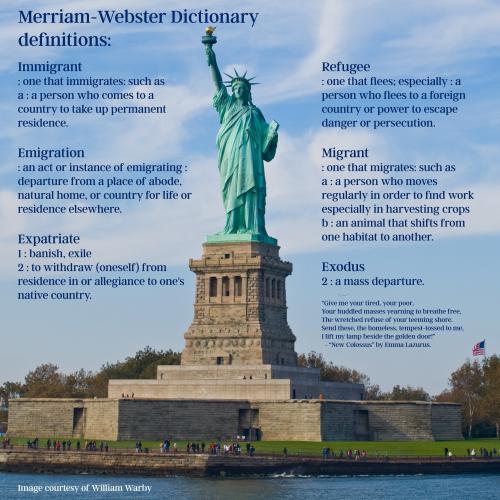
The image features the Statue of Liberty on Liberty Island, standing tall with a torch held high against a partly cloudy sky. The base of the statue and its surrounding area are visible, with tourists walking around the monument. The American flag is flying on the right side of the image.
Overlaying the image are definitions of several immigration-related terms from the Merriam-Webster Dictionary, written in dark blue serif font:
- Immigrant: "One that immigrates: such as a: a person who comes to a country to take up permanent residence."
- Emigration: "An act or instance of emigrating: departure from a place of abode, natural home, or country for life or residence elsewhere."
- Expatriate: "1: banish, exile. 2: to withdraw (oneself) from residence in or allegiance to one's native country."
- Refugee: "One that flees; especially: a person who flees to a foreign country or power to escape danger or persecution."
- Migrant: "One that migrates: such as a: a person who moves regularly in order to find work especially in harvesting crops b: an animal that shifts from one habitat to another."
- Exodus: "2: a mass departure."
Below the definitions, the image also contains an excerpt from the poem The New Colossus by Emma Lazarus:
"Give me your tired, your poor,
Your huddled masses yearning to breathe free,
The wretched refuse of your teeming shore.
Send these, the homeless, tempest-tossed to me,
I lift my lamp beside the golden door!"
In the bottom left corner, a small white text credit reads: "Image courtesy of William Warby."
Upper Peninsula Immigration
For centuries, the land that is now the Upper Peninsula was inhabited strictly by various groups of Indigenous peoples. There were the early Neolithic groups, followed by the Woodland tribes who lived in relative harmony with the natural world. The latest group to call this place home were the Anishinaabeg, or better known by their tribal names, the Ojibwe, Odawa and Pottawatomi.
In the mid-17th century, this all began to change. First, traders from France came to exchange goods for furs. Along with the traders were the missionaries who came to teach the Indigenous tribes the Christian faith. For two centuries, the impact of these new arrivals (eventually joined by English and Scottish peoples) made a slow but significant stamp on the physical world and social order on the Upper Peninsula.
By the mid-19th century, change came at a greater pace as mining and logging operations demanded more and more workers. These workers came from all parts of Europe and help define the very culture that we now know of as the “Yooper way-of-life.”
But immigration of people did not end with the mining and logging booms in the late 19th and early 20th centuries. Slowly over the past 100 years, groups of people have come to the U.P. to seek new lives from all of the continents of the world. They come for opportunity, to escape oppression, for safety and all of the same reasons that all immigrants have come to this land.
This exhibition is about all of these people; what brought them here, what they did, how they lived and what they contributed to this place we call, the Upper Peninsula.